GKS Scholarship Program
GKS Korea Scholarship 2026 Explained: Full Guide for Indian Students
The Global Korea Scholarship (GKS) 2026 is one of the most prestigious fully funded scholarship programs offered by the Government of South Korea for international students. Every year, thousands of students from India dream of studying in Korea through this scholarship because it covers tuition fees, airfare, monthly stipend, Korean language training, medical insurance, and many additional benefits.
The scholarship is managed by the National Institute for International Education (NIIED) under the Korean Ministry of Education. It is specially designed to strengthen global education exchange and build strong international relationships between Korea and participating countries.
For Indian students who want to pursue a Master’s degree, PhD, or Research Program in South Korea, GKS 2026 can become a life-changing opportunity.
What is the GKS Scholarship 2026?
The Global Korea Scholarship (GKS) is a fully funded scholarship program for international students who wish to study at top Korean universities.
Under GKS Graduate Program:
Students can apply for:
Master’s Degree
Doctoral (PhD) Degree
Research Program
Scholarship includes:
Korean language training
Tuition fees
Living allowance
Airfare
Insurance
Research support
The Korean Government introduced this program to:
Increase international student exchange
Promote Korean culture globally
Develop future global leaders
Support academic and research collaboration
According to official 2026 announcements, the total number of GKS graduate scholars has increased significantly for 2026.
Why You Should Choose GKS Scholarship?
Choosing GKS is not only about studying abroad. It is about building an international future.
Major Reasons to Choose GKS
1. Fully Funded Scholarship
You do not need to worry about:
Tuition fees
Living expenses
Flight tickets
Language course expenses
Almost everything is covered.
2. Study in Top Korean Universities
You can study in famous Korean universities like:
Seoul National University
KAIST
Yonsei University
Korea University
POSTECH
3. Korean Language Opportunity
Students receive one year of Korean language training before starting their degree.
4. International Career Growth
After graduation:
Better international job opportunities
Global networking
Research collaborations
Korean company opportunities
5. Korean Culture & Technology
South Korea is famous for:
Advanced technology
K-pop & K-drama
Research innovation
Safe environment
High-quality education
Who is Eligible for GKS Scholarship 2026?
Before applying, students must carefully check eligibility conditions.
Nationality Requirement
Applicant and parents must NOT hold Korean citizenship.
Indian students are eligible.
Educational Qualification
For Master’s Program
Must complete Bachelor’s degree before admission.
For PhD Program
Must complete Master’s degree before admission.
GPA Requirement
Generally:
Minimum 80% marks
OR
Top 20% rank in class
Universities may have additional requirements.
Health Requirement
Applicants must:
Be mentally healthy
Be physically healthy
Age Limit for GKS Scholarship 2026
Graduate Program Age Limit
Generally:
Applicant should be under 40 years old.
For professors or academic professionals, some exceptions may apply depending on category and program.
GKS Scholarship Benefits 2026
One of the biggest reasons students choose GKS is its excellent financial support.
Benefits Included
1. Full Tuition Fee
Entire university tuition is covered.
2. Monthly Allowance
Graduate students receive monthly living expenses.
3. Round Airfare Ticket
Economy class flight ticket to Korea
Return ticket after completion
4. Settlement Allowance
Students receive settlement support after arriving in Korea.
5. Korean Language Training
1 year intensive Korean language course
6. Medical Insurance
Health insurance coverage included
7. Research & Thesis Support
Additional support may be provided for:
Research papers
Printing thesis
Laboratory work
8. TOPIK Reward
Students with high Korean proficiency scores may receive additional benefits.
Types of GKS Application Tracks
There are mainly two application tracks for GKS.
1. Embassy Track
Under Embassy Track:
Students apply through the Korean Embassy in India.
Applicants can choose up to 3 universities.
Advantages
Multiple university choices
Better flexibility
Wider opportunities
Important Features
Embassy conducts first screening
Final selection by NIIED
Who Should Choose Embassy Track?
Students who:
Want multiple university options
Want safer application strategy
Have strong overall profile
2. University Track
Under University Track:
Students apply directly to one Korean university.
University recommends selected students to NIIED.
Advantages
Faster selection process
Strong for research-focused students
Disadvantages
Only one university choice
More risk if rejected
Who Should Choose University Track?
Students who:
Already selected a specific university
Have strong research alignment
Contacted professors earlier
Embassy Track vs University Track
Feature Embassy Track University Track
Application Place Korean Embassy Korean University
University Choices Up to 3 Only 1
Selection Rounds More rounds Fewer rounds
Flexibility High Medium
Competition High Very competitive
Best For General applicants Research-focused applicants
How to Apply for GKS Scholarship 2026?
The application process is extremely important.
Step-by-Step GKS Application Process
Step 1: Read Official Guidelines
Students must carefully read:
Eligibility
Required documents
University list
Timeline
Official announcements are available through:
Study in Korea
Embassy of Korea in India
Step 2: Choose Application Track
Select:
Embassy Track
OR
University Track
Step 3: Prepare Documents
Prepare:
Degree certificates
Transcript
Study plan
Recommendation letters
Passport copies
Certificates
Step 4: Submit Application
For 2026:
Online application submission became mandatory in many cases.
Step 5: Interview & Screening
Some applicants may face:
Embassy interview
University screening
Document verification
Step 6: Final Result
Final selected students receive:
Admission confirmation
Visa guidance
Scholarship notice
Required Documents for GKS Scholarship 2026
Documentation is one of the most important parts.
Important Required Documents
Personal Documents
Passport copy
Birth certificate
Citizenship proof
Academic Documents
Degree certificate
Transcript
Graduation certificate
Scholarship Forms
Personal Statement
Study Plan
Research Proposal (if required)
Recommendation Letters
Usually:
1 or 2 recommendation letters
Language Certificates
Optional but highly recommended:
TOPIK
IELTS
TOEFL
Medical Documents
Medical assessment form
Additional Documents
Awards
Internship certificates
Work experience
Published research papers
Very Important
Many documents require:
Apostille
OR
Embassy authentication
Quota for GKS Scholarship 2026 India
The exact quota changes every year according to NIIED policy.
For 2026:
Overall graduate scholarship quota increased to around 2,000 globally.
India receives:
Separate Embassy Track quota
University Track opportunities
Quota distribution depends on:
Country demand
Diplomatic relations
Academic field priorities
Research categories
Usually:
STEM and research fields receive strong preference.
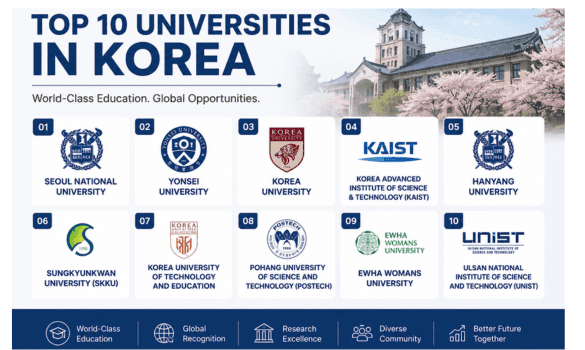
List of Eligible Universities for GKS 2026
Many prestigious Korean universities participate in GKS.
Popular Universities
Seoul National University
KAIST
Yonsei University
Korea University
Hanyang University
Sungkyunkwan University
POSTECH
Pusan National University
Kyung Hee University
Ewha Womans University
The official university list is released every year by NIIED.
Eligible Departments Under GKS
Students can apply to many departments including:
Engineering
AI
Computer Science
Robotics
Mechanical Engineering
Business
MBA
International Business
Economics
Humanities
Korean Language
International Studies
Media & Communication
Science
Biotechnology
Physics
Chemistry
Arts & Design
Fashion
Animation
Visual Communication
Selection Process of GKS Scholarship 2026
The selection process is highly competitive.
Selection Rounds
1st Round
Conducted by:
Korean Embassy
OR
University
Main focus:
Academic profile
Study plan
Recommendation letters
2nd Round
Conducted by:
NIIED
Main focus:
Final screening
Verification
National quota
3rd Round
Conducted by:
University admission review
Some universities may request:
Additional documents
Online interviews
Research proposals
Official Announcement & Notification
Official announcements are usually published on:
Study in Korea Official Website
Embassy of Korea in India
According to the 2026 Embassy of Korea in India notice:
Selected candidates are contacted individually.
All future announcements are updated officially online.
Important Tips to Increase Selection Chances
1. Strong Study Plan
Your study plan should clearly explain:
Why Korea?
Why this major?
Future goals
2. Strong Recommendation Letters
Choose professors who know your academic abilities well.
3. TOPIK or IELTS Score
Language certificates improve competitiveness.
4. Research Experience
Important especially for:
STEM
PhD
Research programs
5. University Selection Strategy
Choose:
Balanced university options
Realistic choices
Strong department match
Common Mistakes Applicants Make
Avoid These Mistakes
Incomplete documents
Wrong notarization
Weak personal statement
Missing deadlines
Random university selection
Poor SOP writing
Why GKS Scholarship is Highly Competitive?
Every year:
Thousands of students apply globally.
Only limited students are selected.
The scholarship is competitive because:
It is fully funded
Korea has top universities
International students receive many benefits
Students with:
Strong GPA
Research experience
Good SOP
Language skills
usually have better chances.
Final Conclusion
The GKS Scholarship 2026 is one of the best opportunities for Indian students who dream of studying in South Korea. It not only provides full financial support but also opens doors toward international education, research opportunities, global careers, and Korean cultural experiences.
Students who prepare early, understand the application process carefully, and submit strong documents can significantly improve their chances of selection.
If you are planning to apply:
Start preparing documents early
Research universities deeply
Improve your SOP and study plan
Follow official announcements regularly
With proper preparation and strategy, GKS can completely transform your academic and professional future.
Official Resources
Study in Korea Official Portal
Embassy of Korea in India
Korea University GKS Information.
TOPIK Exam Complete Guide for Indian Students — Your Korea Dream Starts with Edu Ranii
South Korea has become one of the most popular destinations for Indian students who want to study abroad, build an international career, explore Korean culture, or work in global companies. From K-dramas and K-pop to advanced technology and world-class universities, Korea has created a huge wave of interest among young learners in India.
However, there is one major challenge that stops many students from achieving their dream:
The Korean Language Barrier
Many students want to:
Study in Korea
Apply for scholarships like GKS
Pass the TOPIK exam
Work in Korean companies
Communicate confidently in Korean
But they often do not know:
Where to start
How to learn Korean from Hindi
Which course to follow
How to prepare for TOPIK
How to practice speaking
Which materials are actually useful
This is exactly where Edu Ranii – Language Queen helps students transform their Korean learning journey in a structured and professional way.
What is the TOPIK Exam?
The TOPIK (Test of Proficiency in Korean) is the official Korean language proficiency exam conducted for international learners.
It is one of the most important examinations for students who want to:
Study in South Korea
Apply for GKS Scholarship
Work in Korean companies
Apply for Korean universities
Improve Korean communication skills
Build careers connected to Korea
TOPIK measures:
Reading
Listening
Writing
Vocabulary
Grammar understanding
The exam is recognized globally and accepted by Korean universities and institutions.
Why is TOPIK Important for Indian Students?
Today, thousands of Indian students are learning Korean because Korea offers:
Better international education opportunities
Scholarships
Job opportunities
Research programs
Cultural exchange opportunities
But without Korean language skills, students may face many difficulties.
Problems Students Face Without Korean Language Skills
1. Difficulty Understanding Korean Classes
Many university lectures in Korea include Korean communication, assignments, or academic discussions.
Without Korean:
Students feel lost
Communication becomes stressful
Classroom confidence decreases
2. Scholarship Competition Becomes Harder
Programs like:
GKS Scholarship
University scholarships
prefer students who already understand Korean.
Students with:
TOPIK certificates
Korean speaking ability
Strong language foundation
often have better selection chances.
3. Daily Life Becomes Difficult
Simple activities become challenging:
Ordering food
Using transportation
Shopping
Asking for help
Understanding signs
Even basic communication can feel stressful without Korean knowledge.
4. Limited Job Opportunities
Many Korean companies prefer candidates who can:
Speak Korean
Understand Korean work culture
Communicate professionally
Without language skills:
Internship opportunities become limited
Career growth becomes slower
5. Lack of Confidence
One of the biggest struggles students face is fear:
Fear of speaking
Fear of mistakes
Fear of pronunciation
Fear of not understanding native speakers
This fear often stops students from progressing.
How to Start Learning Korean from Hindi?
This is one of the most common questions Indian students ask.
Many students think Korean is extremely difficult, but with the right roadmap and structured learning system, Korean becomes much easier.
The biggest mistake beginners make is:
Learning random vocabulary
Watching unstructured videos
Memorizing without understanding grammar
Depending only on Romanized Korean
A proper learning structure is extremely important.
The Right Korean Learning Roadmap for Beginners
Step 1: Learn Hangul Properly
Hangul is the Korean alphabet system.
Students should first:
Learn Korean vowels
Learn consonants
Practice pronunciation
Read simple Korean words
Without strong Hangul basics, future learning becomes difficult.
Step 2: Build Basic Vocabulary
Students should learn:
Daily life words
Greetings
Numbers
Family vocabulary
Common expressions
Step 3: Understand Korean Grammar
Grammar is the foundation of Korean communication.
Students must learn:
Sentence structure
Particles
Verb endings
Tenses
Daily grammar patterns
Step 4: Listening & Speaking Practice
Language learning is not only memorization.
Students should:
Listen daily
Practice speaking loudly
Repeat Korean sentences
Build pronunciation confidence
Step 5: TOPIK Preparation
After building basics:
Vocabulary expansion
Mock tests
Reading practice
Listening speed improvement
Writing structure training
become important.
Why Many Students Fail to Learn Korean Properly
Many learners quit Korean because:
They study without structure
They use too many resources together
They do not get proper guidance
They feel overwhelmed
They focus only on memorization
This creates confusion and frustration.
Students need:
A step-by-step roadmap
Beginner-friendly explanations
Consistent practice
Simple Hindi explanations
Structured progression
How Edu Ranii Helps Students Learn Korean Properly
Edu Ranii — Language Queen
Edu Ranii was created with one mission:
To Make Korean Learning Simple, Structured, and Accessible for Indian Students
Many students struggle because most Korean learning resources are:
Fully English-based
Difficult for beginners
Unstructured
Confusing
Edu Ranii focuses on:
Hindi to Korean learning
Beginner-friendly explanations
Structured lessons
Real Korean usage
Step-by-step growth
What Makes Edu Ranii Different?
1. Structured Korean Learning System
Instead of random lessons, students get:
Proper learning order
Daily progression
Grammar structure
Vocabulary systems
Practice-oriented learning
This helps students avoid confusion.
2. Hindi to Korean Teaching Method
Many Indian students understand concepts faster in Hindi.
Edu Ranii explains:
Grammar in Hindi
Korean sentence patterns clearly
Real examples for daily communication
This makes Korean easier for beginners.
3. Beginner to Advanced Roadmap
Students can start from:
Absolute beginner level
to
TOPIK preparation level
The learning process is organized step-by-step.
4. Free Korean Courses
One of the strongest features of Edu Ranii is accessibility.
Students can access:
Free Korean lessons
Free grammar explanations
Beginner learning materials
Vocabulary support
Practice content
This helps students begin learning without financial pressure.
5. Free Study Materials
Edu Ranii provides:
PDFs
Grammar notes
Vocabulary resources
Practice materials
Learning guidance
Structured materials help students revise effectively.
6. Practical Korean Learning Approach
The focus is not only theory.
Students learn:
Daily conversations
Real Korean usage
Pronunciation
Speaking confidence
Practical communication
7. TOPIK-Oriented Preparation
Students preparing for TOPIK can practice:
Vocabulary
Reading
Listening
Grammar
Exam patterns
This creates strong exam preparation foundations.
Why Structured Korean Learning is Important
Language learning without structure is like:
Traveling without a roadmap
Students often:
Learn advanced grammar too early
Ignore pronunciation
Skip fundamentals
Forget vocabulary quickly
Structured learning solves these problems by creating:
Proper progression
Better retention
Confidence building
Long-term fluency
This is why structured Korean education matters.
How Korean Language Can Change Your Future
Learning Korean can open many opportunities:
Education
Korean universities
Scholarships
Exchange programs
Career
Korean companies
Translation
International business
Tourism industry
Global Exposure
Cultural understanding
International networking
Academic growth
Personal Growth
Communication confidence
New experiences
Skill development
TOPIK Preparation Tips for Indian Students
1. Focus on Daily Consistency
Even:
30 minutes daily
can create major improvement.
2. Practice Listening Regularly
Listening improves:
Pronunciation
Understanding speed
Real conversation skills
3. Build Vocabulary Slowly
Do not memorize thousands of words at once.
Instead:
Learn daily practical words
Revise regularly
4. Practice Korean Sentence Formation
Understanding sentence structure is essential.
5. Use Structured Learning Platforms
Following one organized system is much better than using random sources.
The Future of Korean Language Learning in India
The popularity of Korean language in India is growing rapidly because of:
Korean entertainment
Scholarships
International careers
Study abroad opportunities
Korean companies expanding globally
As competition increases, students with:
Strong Korean skills
TOPIK certificates
Structured preparation
will gain major advantages.
Final Conclusion
The TOPIK exam is not just a language test. It is a gateway toward:
Korean universities
Scholarships
International careers
Global opportunities
However, success in Korean learning requires:
Proper guidance
Consistency
Structured learning
Real understanding
For Indian students starting from zero, learning Korean can initially feel difficult and confusing. But with the right roadmap and beginner-friendly system, Korean becomes achievable step-by-step.
Edu Ranii — Language Queen aims to simplify this journey by providing:
Structured Korean courses
Hindi to Korean explanations
Free learning materials
Practical Korean education
Beginner-friendly guidance
For students dreaming about Korea, the first step always begins with language learning.
And the stronger your Korean foundation becomes, the closer your Korea dream moves toward reality.